Register a contract
Record the source, destination, object, field authority and delivery requirement for each data flow.
- Receives
- Integration requirement and object model
- Produces
- Versioned connection contract

Coordinate the flow of customer and campaign data with defined contracts, transformation rules and operational visibility.
Let’s connect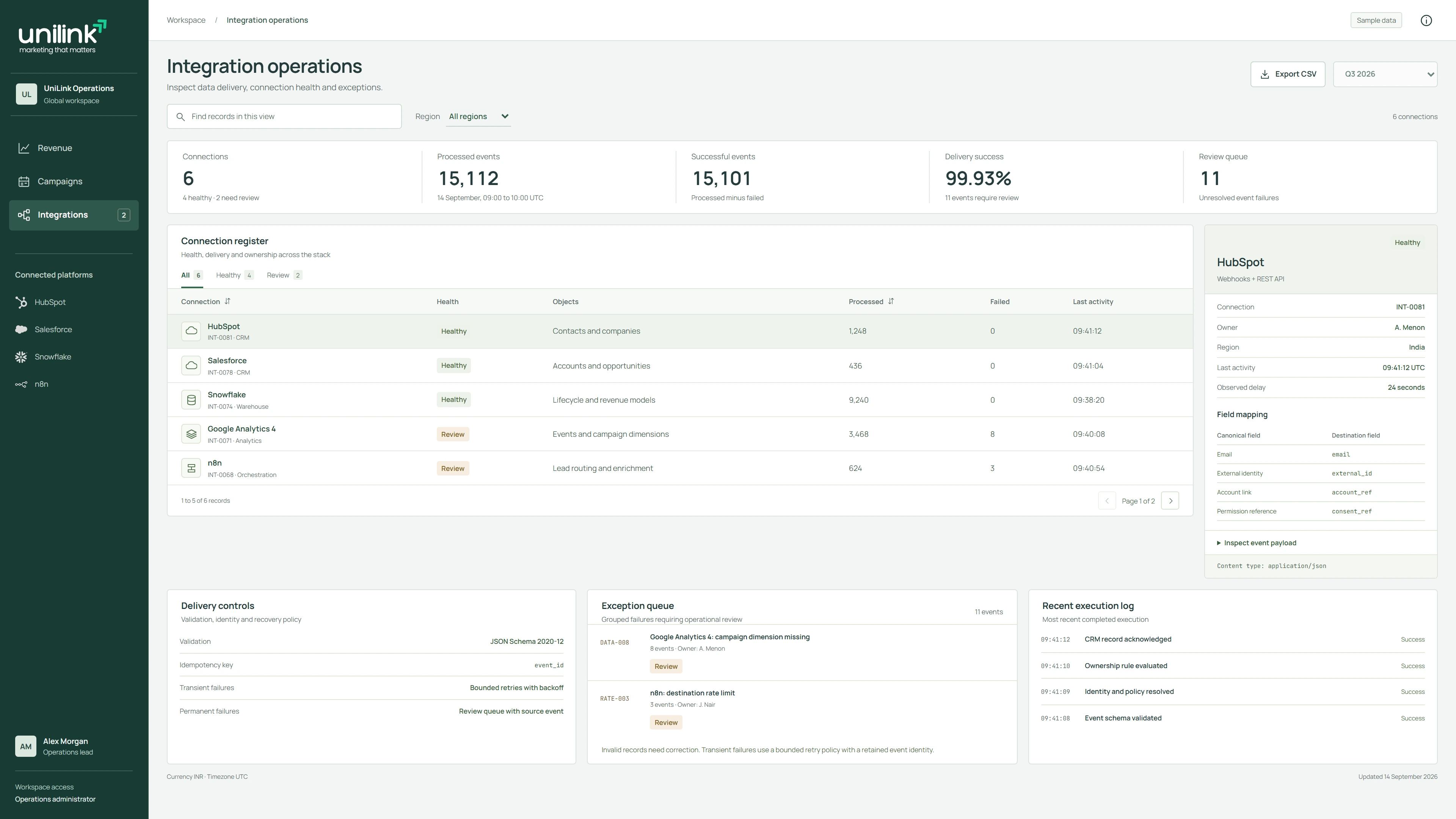
Make source contracts, execution state and recovery visible across integrations while keeping business ownership with the relevant teams.
Record the source, destination, object, field authority and delivery requirement for each data flow.
Authenticate, normalize and deduplicate incoming work before calling the destination.
Track freshness, backlog, failures and reconciliation gaps by flow and business owner.
Replay selected work using retained identifiers and evidence of previous destination effects.
Select a field to examine its owner, permitted changes and conflict handling. Clear ownership keeps updates consistent across systems.
| Field or object | Accountable owner | Mapping and control |
|---|---|---|
| Integration owner | Links contract, executions and operating documentation. | |
| Extraction process | Moves only after the relevant work is safely recorded. | |
| Destination platform | Supports reconciliation after an uncertain response. |
A successful HTTP response is not always proof that the intended business process completed. Record both levels.
A shared monitoring layer can standardize escalation while each destination keeps its own retry and conflict policy.
Select the scenarios to discuss with your implementation team.
The integration hub is a solution scope for managing connections that would otherwise be scattered across individual automations. It establishes common standards for identity, field mapping, execution records and exception handling across your marketing and revenue ecosystem.
The architecture may combine existing integration platforms with custom services. We choose the implementation based on required control, system access, volumes and operating responsibilities. A central hub is useful where it simplifies ownership and observability, rather than becoming an unnecessary dependency.
Document each integration, its purpose, source and destination owners and operational dependencies.
Define schemas, identifiers, field precedence and the treatment of updates and deletions.
Normalize approved payloads and direct events to the relevant downstream process.
Track failures, support safe replay and compare system state to identify missing updates.
Authenticate the source and validate the payload against the agreed contract.
Apply mapping rules and send the appropriate data to each destination.
Record the outcome and identify exceptions that require retry or review.
Read the contracts, controls and failure behavior behind a maintainable implementation.
No. Simple connections may be best handled by native integrations. A hub is considered when shared controls and operational visibility justify it.
The implementation defines secure credential storage, access boundaries and rotation ownership. Credentials are never embedded in public frontend code.
Tell us where your operations are today. We’ll help you see what comes next.