Register work
Capture the objective, owner, brand, channel and dependencies in a structured campaign record.
- Receives
- Request and planning context
- Produces
- Campaign identifier and work package

Bring requests, campaigns, audiences and reporting into an operating environment designed around your team.
Let’s connect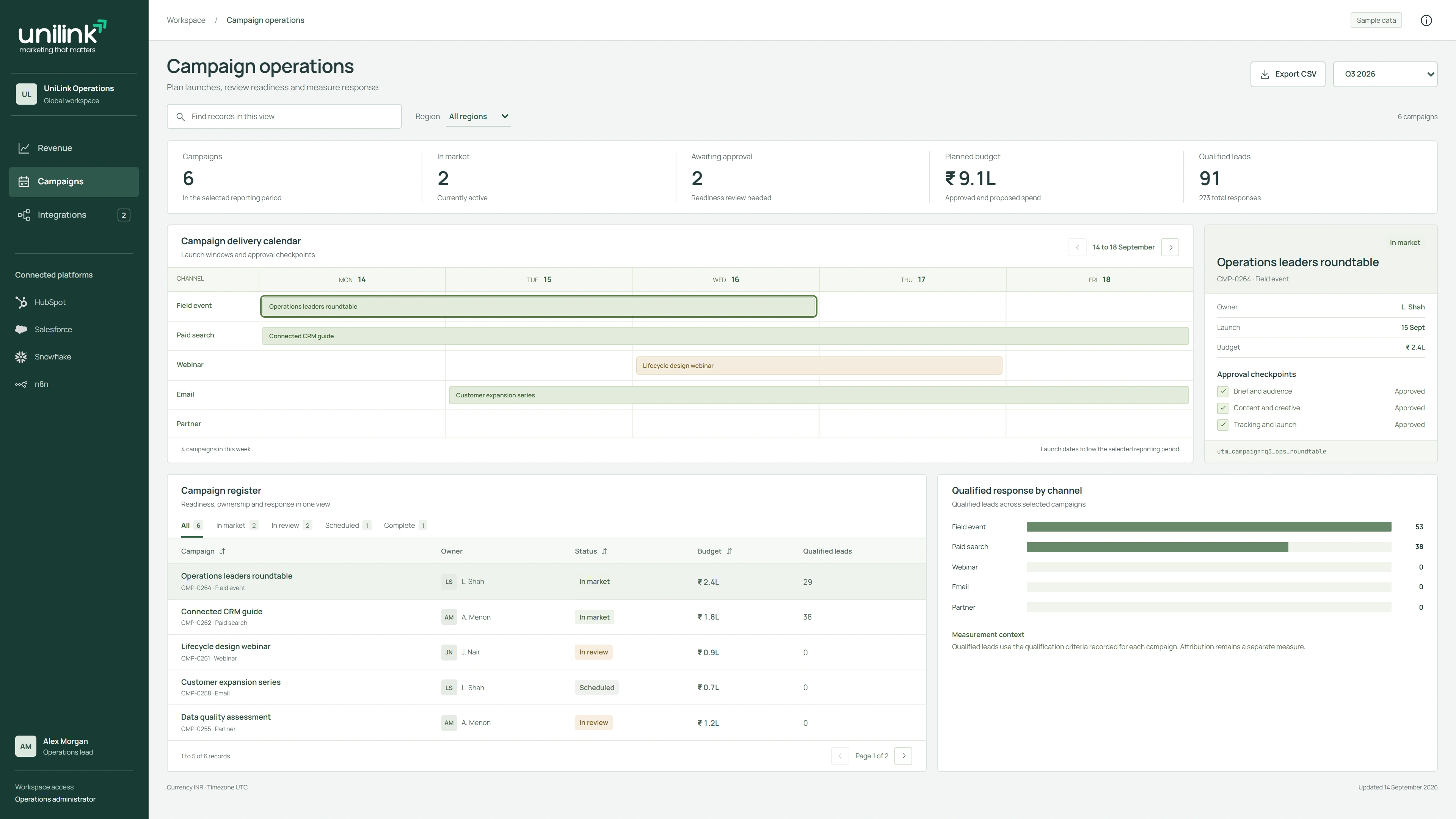
Use one campaign key to connect requests, work, approvals and results while each connected system retains a clear responsibility.
Capture the objective, owner, brand, channel and dependencies in a structured campaign record.
Translate the package into assigned tasks and milestone dependencies in the selected work system.
Evaluate readiness using the approved asset version, audience logic and channel checks.
Compare actual stage timestamps with planned dates and link the resulting campaign performance.
Select a field to examine its owner, permitted changes and conflict handling. Clear ownership keeps updates consistent across systems.
| Field or object | Accountable owner | Mapping and control |
|---|---|---|
| Marketing operations | Shared across planning and reporting records. | |
| Work platform | Retains the relationship to its campaign. | |
| Channel owner | Separates ready, scheduled, active and paused states. |
A shared workspace can coordinate work without duplicating every feature of the CRM or activation tool.
An approval record must reference what was reviewed, not merely the campaign name.
Select the scenarios to discuss with your implementation team.
The marketing operations platform is a solution scope for connecting the work behind your campaigns. It brings together intake, planning, ownership, governance and reporting so teams can see how their work relates to the wider marketing calendar.
The implementation can extend existing platforms or combine them with tailored interfaces and integrations. Discovery determines the workflow, data model, access requirements and reporting needs. It also establishes where the platform should remain flexible and where common standards are essential.
Collect campaign objectives, audiences, channels, dependencies and requested dates in a consistent brief.
Link tasks, assets, audience references and measurement identifiers to a shared campaign record.
Create role appropriate views of workload, approvals, delivery status and the information needed to unblock work.
Make required reviews, naming standards and ownership visible within the process.
A brief enters a shared queue and is assessed against capacity, completeness and business priority.
Owners, dependencies and approval requirements are assigned to the campaign record.
Release checks and reporting references connect execution to an operational review.
Read the contracts, controls and failure behavior behind a maintainable implementation.
Modules and integrations are selected around your campaign processes, approval requirements and existing platforms. The implementation plan defines the shared functions and the variations each team needs.
The operating model can distinguish shared governance from local execution, with agreed fields and approval rules across regions.
Tell us where your operations are today. We’ll help you see what comes next.