Define
Agree the audience, offer, channel, dates and primary decision the campaign should inform.
- Receives
- Campaign brief
- Produces
- Scoped campaign and taxonomy

Coordinate the people, assets and approvals behind every campaign in one connected process.
Let’s connect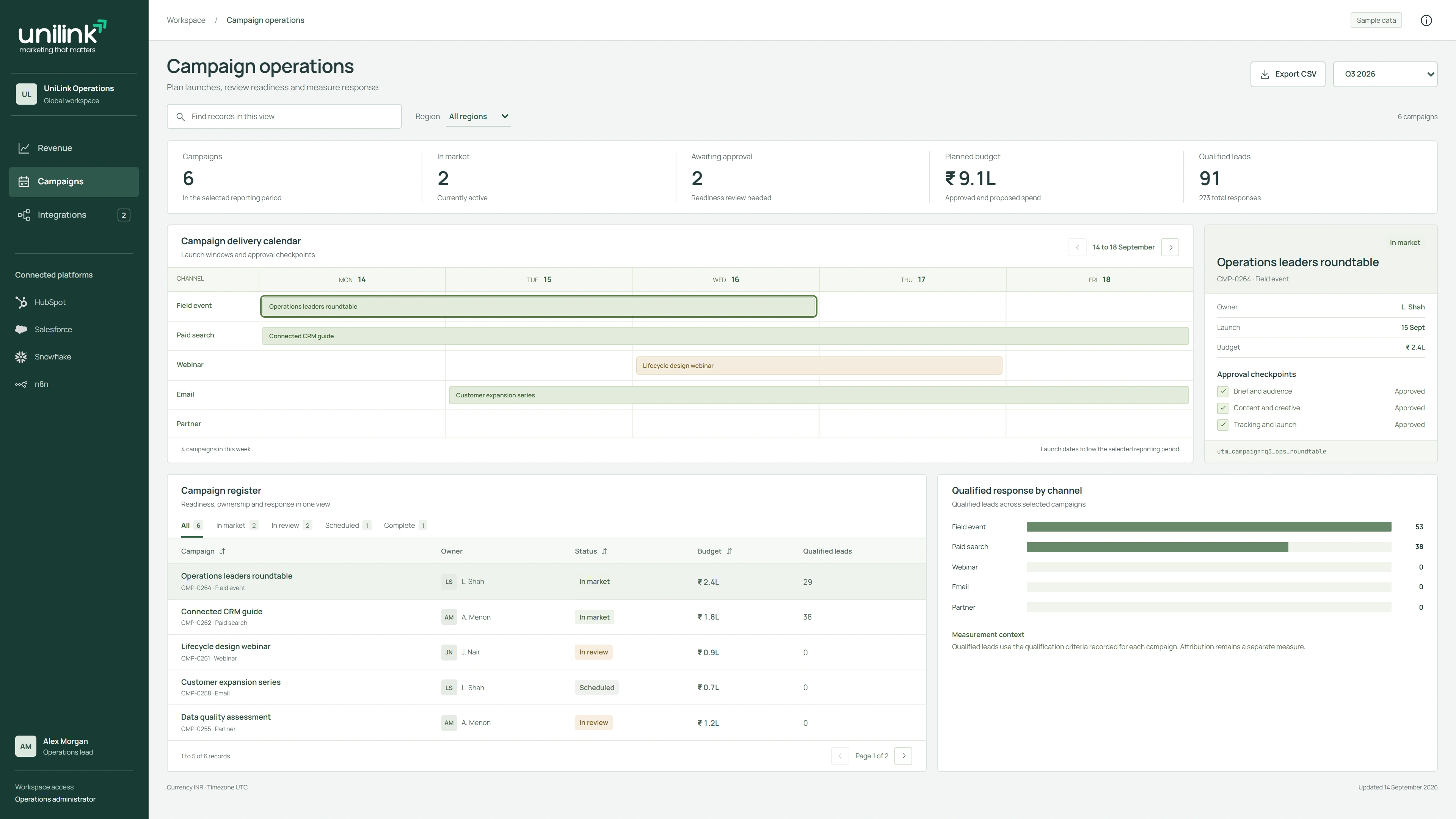
The campaign model ties business intent to concrete assets, eligible audiences and a consistent measurement key.
Agree the audience, offer, channel, dates and primary decision the campaign should inform.
Link the approved creative version, destination, audience rules and tracking parameters.
Validate channel readiness and capture the actual activation references and timestamps.
Bring delivery and outcome data back to the campaign key with documented date windows.
Select a field to examine its owner, permitted changes and conflict handling. Clear ownership keeps updates consistent across systems.
| Field or object | Accountable owner | Mapping and control |
|---|---|---|
| Marketing operations | Uses a controlled taxonomy shared with UTM parameters. | |
| Creative team | Includes a version and destination. | |
| Channel platform | Stores the actual time and timezone. |
A campaign can contain several channel activities. Keep activity identifiers to diagnose partial launches.
Fix the observation window before comparing campaigns that launched on different dates.
Select the scenarios to discuss with your implementation team.
A campaign is more than a collection of tasks. It has an audience, an objective, a budget, a sequence of dependencies and a measurement plan. This solution organizes those elements into a record that remains useful from planning through performance review.
We map how campaigns move through your organization, then define the workflow, views and connections that support it. The scope can include calendar planning, deliverable tracking, asset references, channel readiness and campaign reporting.
Represent programs, campaigns and channel activities without losing their relationship in reporting.
Make launch dates, prerequisites and resource conflicts visible before commitments are made.
Track content, audience, tracking and approval checks against agreed launch criteria.
Connect campaign IDs and objectives to the reports used in the review.
Document the audience, objective, success measure, channels and responsibilities.
Coordinate deliverables and review dependencies with a visible owner for each task.
Complete readiness checks and preserve the campaign record for measurement and learning.
Read the contracts, controls and failure behavior behind a maintainable implementation.
Those platforms are part of the ecosystem we assess. The connection depends on your workspace structure, permissions and the data the workflow requires.
Campaign planning and governance can form part of the engagement. Objectives, audience strategy and creative responsibilities are agreed during scoping.
Tell us where your operations are today. We’ll help you see what comes next.