
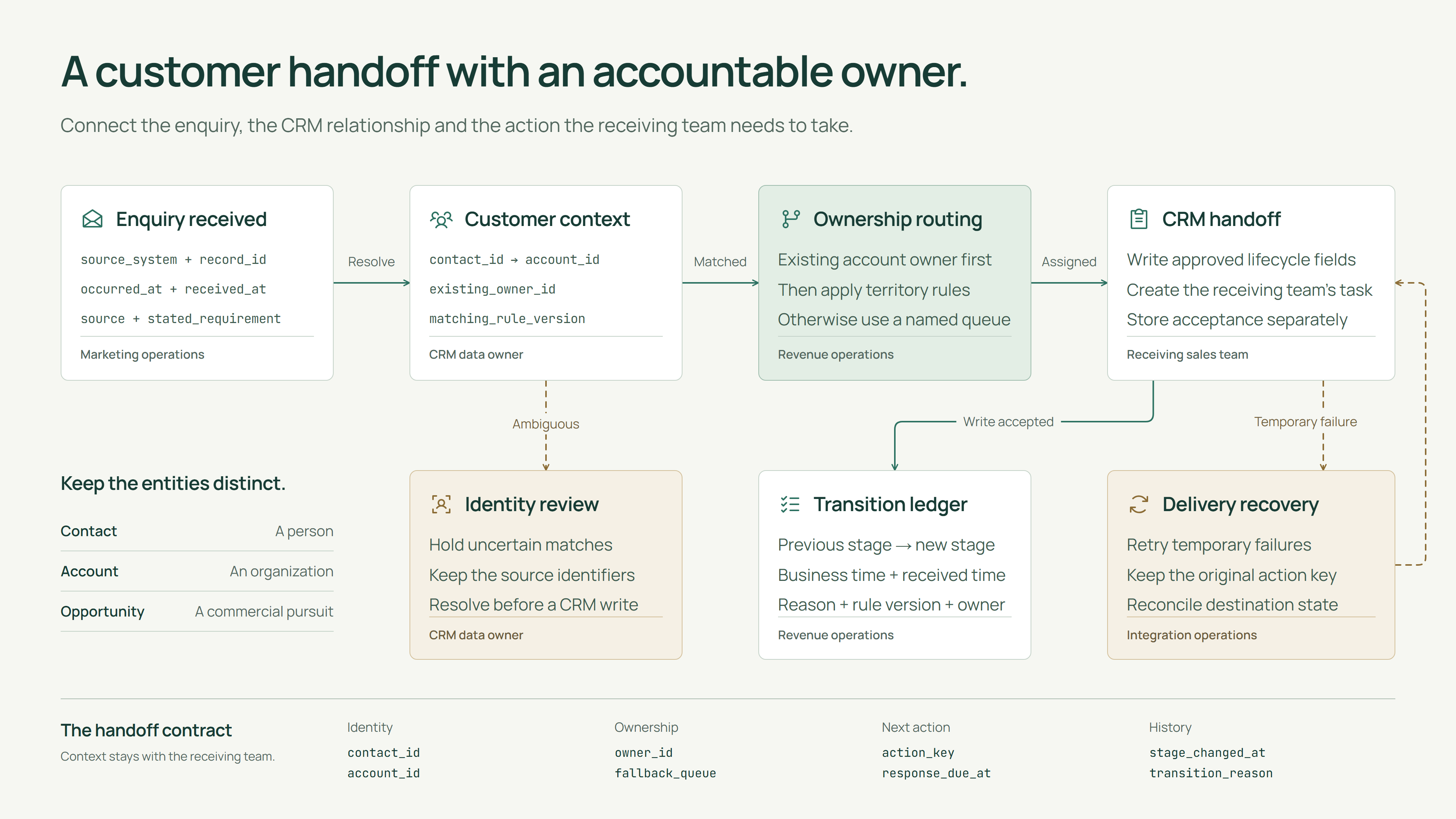
Start with the relationship you are describing
Before choosing stage names, decide whether the lifecycle describes a person, an account or an opportunity. These are related records with different meanings. One account can have several contacts and several opportunities at the same time. Moving a contact to a customer stage does not explain which opportunity was won or which service the account purchased.
A useful model states the responsibility of each entity. Contacts represent people, accounts represent organizations and opportunities represent commercial pursuits. Additional entities may be appropriate for subscriptions, projects or program interests. Their relationships should be explicit enough for both automation and reporting to use consistently.
Give each stage a decision rule
A lifecycle stage needs more than a label. Record its entry criteria, exit criteria, accountable owner and required information. If a stage is called sales accepted, specify the evidence of acceptance and who records it. If qualification depends on a score, document the inputs and the reason the threshold is meaningful.
Separate status from activity. Opening an email or attending an event is an interaction, not automatically a change in commercial state. Those signals may inform qualification, but the transition should reflect an agreed business decision. This distinction makes the process easier to explain and prevents noisy events from rewriting the lifecycle.
Design the handoff as a small contract
Each handoff should define what the receiving team needs, when it should respond and what happens if the record is incomplete. Useful context may include the enquiry source, account relationship, stated requirement and recent relevant activity. A notification that only says a new lead exists is rarely enough.
Ownership precedence also matters. An existing customer may need their account owner, while a new prospect may follow territory rules. A named fallback queue prevents a record from becoming unowned when no rule matches. Escalation should create an actionable task rather than an accumulating stream of alerts.
Treat exceptions as part of the model
Plan for a person changing company, an opportunity reopening, a duplicate record being merged and a customer making a new enquiry. These are ordinary business events. The model should state which history is preserved, which ownership changes and whether a record can enter a journey again.
Keep stage transition timestamps where historical analysis requires them. A current stage property cannot answer how long a record spent in a previous stage unless the history is available. Define the reporting requirement before choosing how to store it, and distinguish a first entry from the most recent entry.
Keep a transition ledger alongside current state
Where historical analysis matters, retain a transition record with the entity reference, previous stage, new stage, business timestamp, reason and rule version. Store the time the event was received separately. This allows an operations team to distinguish a customer who moved slowly through the process from a data feed that delivered the transition late.
Decide whether duration measures use the first entry, most recent entry or every stay in a stage. A recycled lead can enter qualification several times, and those definitions will produce different results. Use representative histories to agree the interpretation before calculating averages. Keep the current CRM stage for ordinary work and use the transition history for questions that require the earlier states.
Validate the process with real scenarios
Walk through representative records with marketing, sales and customer success. Include a new prospect, an existing customer, an account with several contacts and an enquiry that should be disqualified. Ask each team to identify the current owner, expected next action and information needed to proceed.
Publish the agreed lifecycle as a short operational reference, then review it when your selling model changes. Measure data completeness and handoff performance as well as conversion. The outcome is a shared decision framework that can be implemented in a CRM and understood outside it.